The most ordinary story.
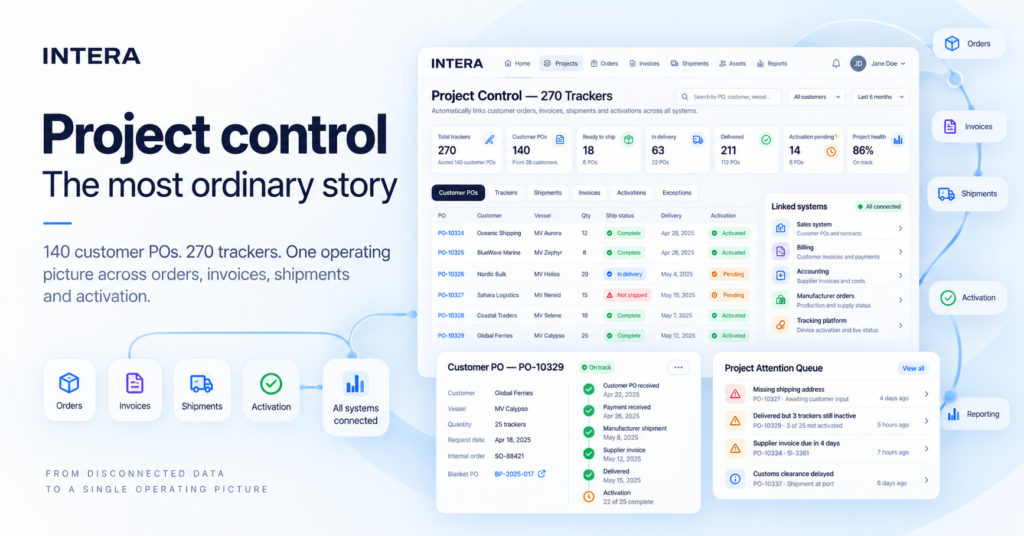
We receive a pre-order for 270 satellite trackers. Great achievement for Sales team. Now the backoffice needs to sweat a bit to make this happen. All the individual steps are easy, but managing the process to reach the goal is a significant issue.
How the process usually works
A new Sales Opportunity goes into our Sales system.
Our customer’s individual business units starts to send us separate Purchase Orders, two trackers at a time. At this stage, they do not yet provide delivery addresses. Each individual PO has its own reference number.
When we receive a PO, we issue an invoice to the relevant business unit. The customer’s PO number is always included in the invoice details.
The customer’s payment agent then pays these invoices. Gradually or all together – they decide.
Once an invoice is paid, we inform the relevant customer’s business unit that the equipment is ready for shipment. They need to urgently provide a shipping address.
From our side, we place a blanket PO with the manufacturer covering the full project.
Once we have shipping instructions from the customer’s business unit and provided that the corresponding invoice had already been paid, we place an individual shipment order with the manufacturer.
Each shipment order includes both our blanket PO number and our own internal order reference. That internal reference allows us to identify exactly which customer PO and invoice the shipment belongs to.
Manufacturer ships our order out. Send us tracking details. We store these details in our sales support system.
For each shipment, the manufacturer issues an invoice covering both the tracker and the delivery cost. The invoice contains our blanket PO reference as well as the individual order reference.
We register the supplier invoice in our accounting system and then issue an additional invoice to the customer for the delivery cost. This delivery invoice also references the customer’s original PO.
The customer’s payment agent pays these additional invoices.
And in the above very simple manner we follow each and every Order until all trackers are delivered.
After delivery, we inform the customer and await activation instructions.
Once those instructions are received, we activate trackers and add them to a tracking platform.
The manufacturer’s invoices have 30-days payment terms, so we also have to monitor them and make sure all bills are paid on time.
What we actually need to control
Throughout the project, we need to know:
- Have all customer business units submitted their equipment orders, so that we eventually reach all 270 units?
- Has every customer PO been invoiced?
- Has every invoice been paid?
- For every paid order, do we have tracking information confirming that it has actually been shipped?
- Have we received the manufacturer’s invoice for every shipment?
- Have we issued the additional delivery invoice to the customer?
- Has the payment agent paid that delivery invoice?
- Have we paid every manufacturer invoice, and did we pay it on time?
- Has every delivered tracker been activated?
- Has every activated tracker been added to the tracking platform?
Where the complexity really appears
No individual step is particularly complicated. No additional staff are required. Everyone involved simply continues doing their usual job. The whole company is involved though. Sales, accounting, billing, procurement, tech support – each department is doing their job.
The difficulty is knowing, at any moment, whether all of these steps agree with each other across the entire project.
And once you have over 100 individual POs, the job suddenly becomes extremely complicated.
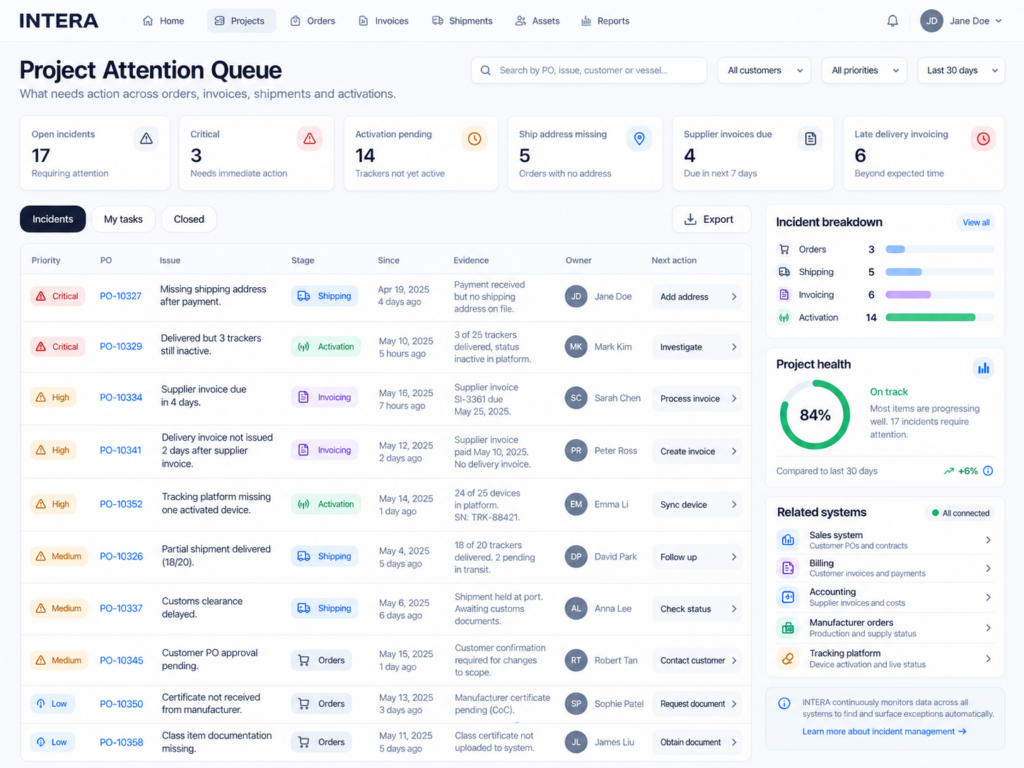
Every process works perfectly well on its own. And traditionally, one manager ends up trying to maintain the overall picture — checking what has been ordered, paid, shipped, invoiced, delivered and activated.
The manager becomes the integration layer
That person quickly becomes the bottleneck.
With INTERA, this is much simpler.
What changed with INTERA
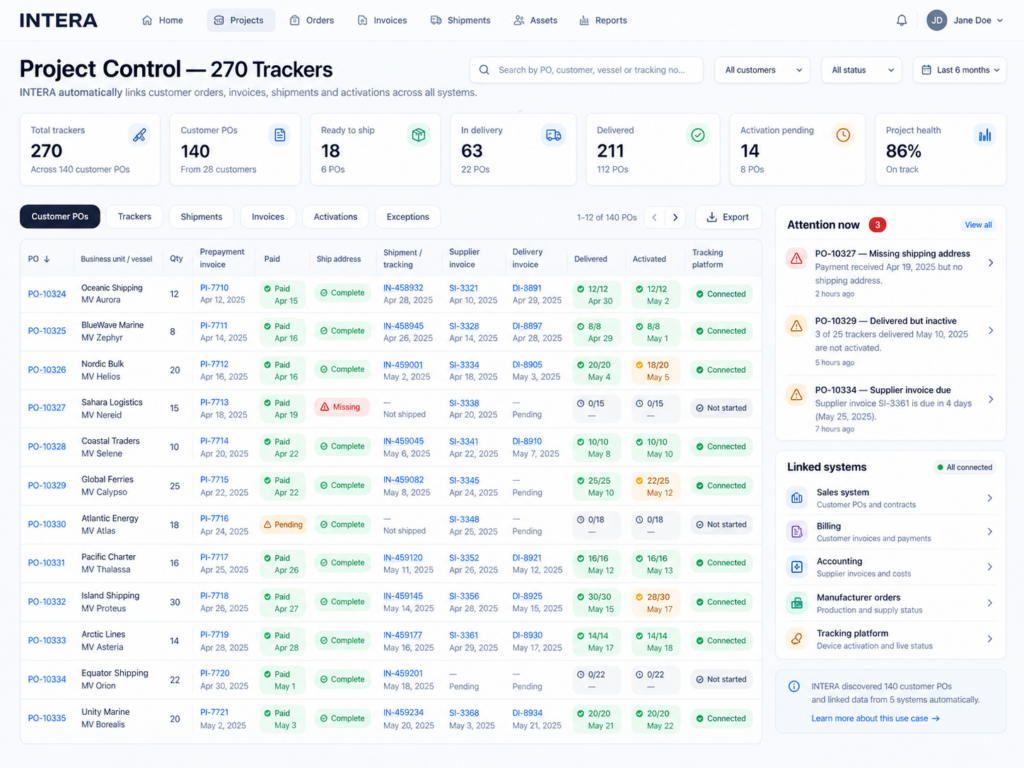
We created an Asset Group for the project, with each customer PO represented as an Asset.
INTERA then discovered the customer POs automatically from our sales system and linked the relevant information from the other systems:
- tracker prepayment invoices from billing;
- payment status;
- notification that a shipping address was required once payment was received;
- shipment and tracking information from the sales system;
- the manufacturer’s cost invoice from accounting;
- the additional customer shipping invoice from billing;
- delivery status;
- tracker activation status;
- confirmation that the activated tracker had been correctly added to the network tracking system.
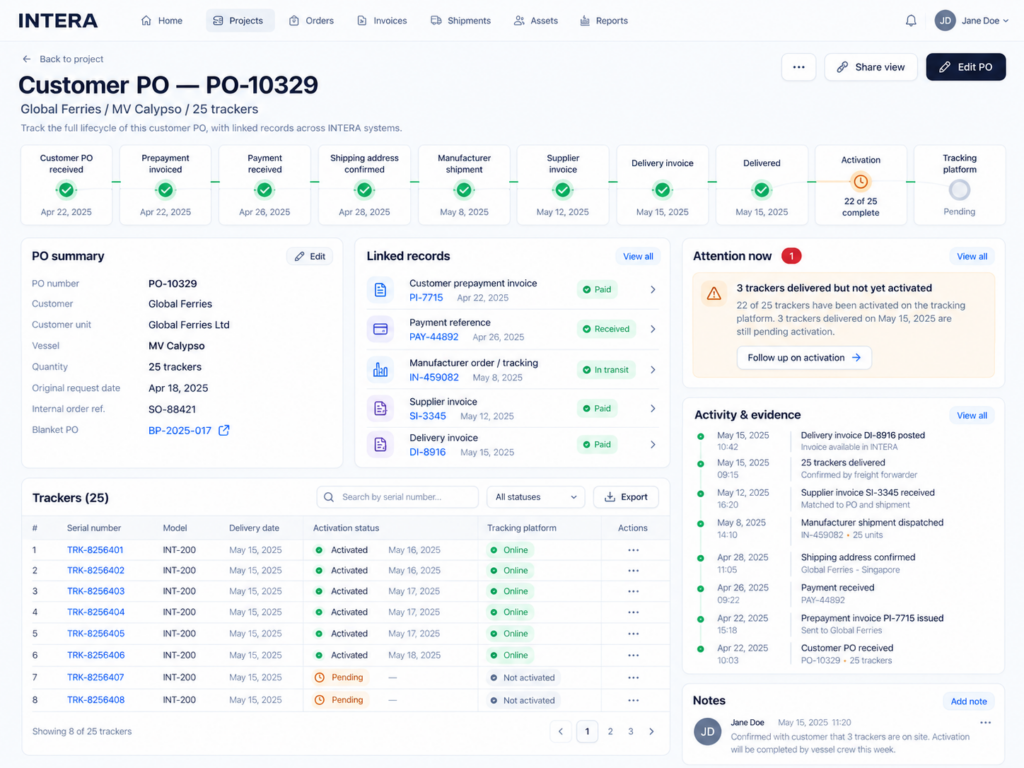
If a tracker was delivered but still inactive, INTERA highlighted it and reminded us to follow up with the customer.
Once activated, INTERA checked that the relevant tracking information had also appeared correctly in the network system.
There was no additional data entry in INTERA.
People continued using the same systems they were already using. INTERA simply linked the evidence together and showed us what was complete, what was missing and what required attention.